blogBy Toyow Team 26 March 2026
Real-World Assets Are Moving Onchain
TL;DR
- The Data: Tokenized real-world assets (RWAs) have reached $20.8B+ in distributed onchain value (Source: RWA.xyz).
- The Shift: The market is moving from pilots toward production-grade infrastructure.
- The Opportunity: While tokenized treasuries dominate early volume, the next phase broadens into illiquid assets (real estate, commodities, and IP).
- The Structure: Scaling participation in 2026 favors multi-category, compliance-first marketplaces over fragmented, single-vertical silos.
For years, blockchain innovation was largely confined to native digital assets.
That phase is ending.
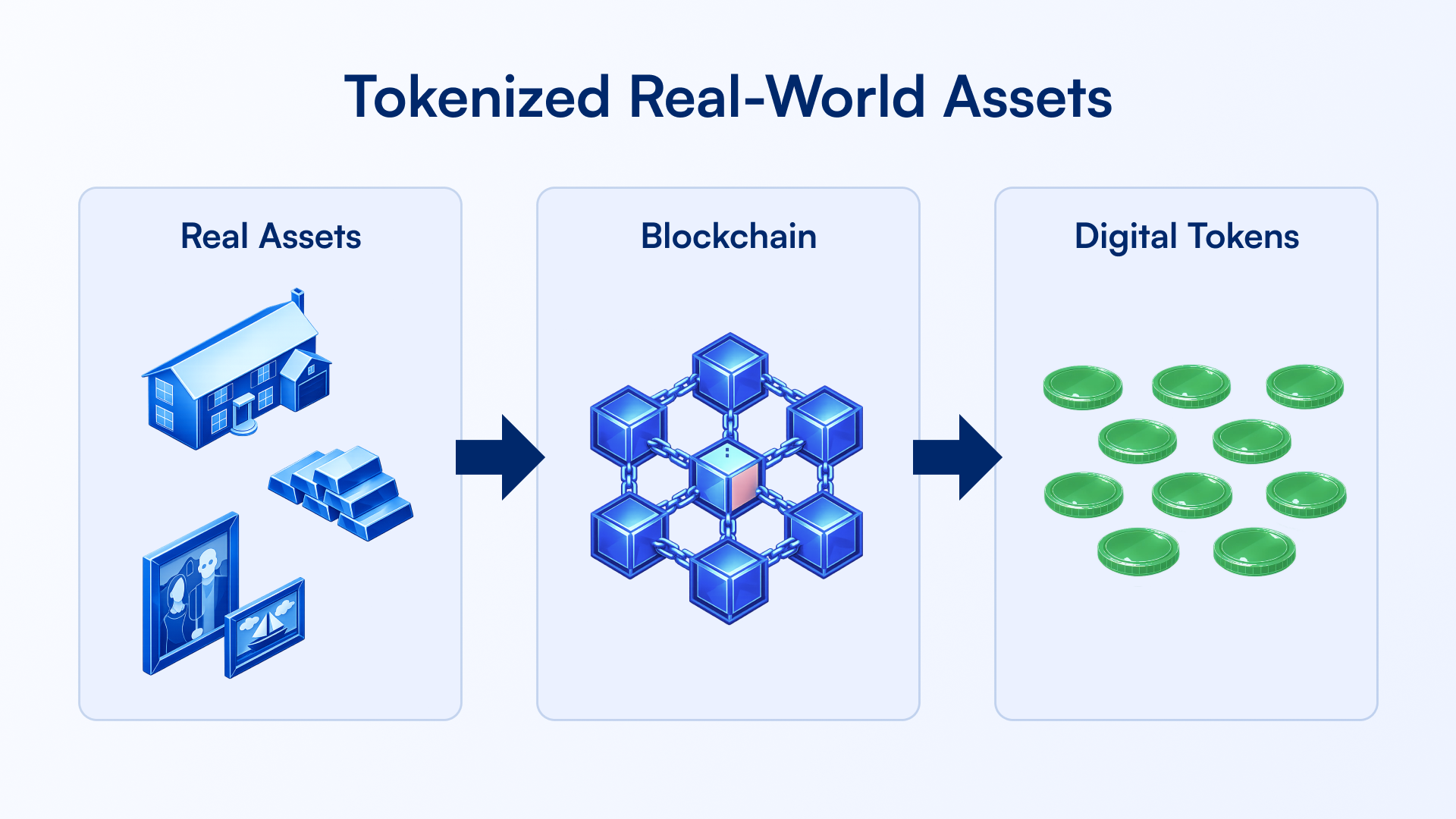
A new wave is now taking shape—one where real-world assets (RWAs) such as real estate, commodities, art, film, and music are being tokenized and managed on compliant, onchain infrastructure.
This is not a speculative trend. It is a structural shift in how assets are issued, accessed, and settled.
And it’s happening faster than many expected.
From Experiments to Infrastructure
Tokenization began with pilots. Small proofs of concept. Isolated experiments.
Today, it is becoming production-grade financial infrastructure.
Global estimates suggest that tokenized RWAs have grown from low single-digit billions just a few years ago to over $20.8B in distributed onchain value today. Some forecasts project tokenization volumes reaching significantly higher levels over the course of this decade.
What changed?
Three forces converged:
- Institutional demand for efficiency
- Maturing compliance expectations across multiple regions
- More reliable onchain infrastructure and market plumbing
Large financial institutions have openly stated that tokenization represents the next phase of capital markets, not a parallel system.
Why Traditional Assets Are a Natural Fit for Tokenization

Most real-world assets share the same structural problems:
- High minimum participation sizes
- Illiquidity and long settlement cycles
- Geographic and jurisdictional barriers
- Opaque ownership and manual administration
Tokenization directly addresses these inefficiencies.
By representing ownership digitally, assets can be:
- Fractionalized, lowering capital barriers
- Settled faster, often near-real-time
- Accessed globally, subject to eligibility requirements and compliance limits
- Tracked transparently, with auditable records
This does not change the asset itself.
It changes the rails the asset moves on.
The Institutional Signal Is Unmistakable

The strongest validation of RWA tokenization has come not from crypto startups, but from institutions with the most to lose by being wrong.
BlackRock's BUIDL fund became the largest tokenized treasury product onchain, crossing $500M in assets. JPMorgan's Kinexys — formerly Onyx — has processed over $1.5 trillion in tokenized overnight repo transactions since launch. Franklin Templeton's FOBXX operates across multiple public blockchains. Fidelity filed to launch a tokenized money market fund. These are not proofs of concept. They are production commitments from institutions managing trillions in combined assets.
The reason is consistent across all of them: operational efficiency at scale.
Reduced reconciliation costs. Shorter settlement windows. Programmable compliance embedded directly into the asset lifecycle.
These are not theoretical advantages. They compound as transaction volumes grow, as more asset classes come onchain, and as markets begin to demand the kind of transparency that only onchain infrastructure can deliver. Tokenization is being absorbed into mainstream financial architecture — not as an experiment, but as the next layer of market plumbing.
Why Multi-Category Marketplaces Matter

Most early RWA platforms focused on single asset classes—only real estate, only credit, or only commodities.
That approach solved individual problems but created fragmentation.
The next phase of adoption requires aggregation, not silos.
A multi-category marketplace enables:
- Portfolio diversification across asset types
- Shared compliance and onboarding infrastructure
- Unified discovery and user experience
- Liquidity concentration rather than dispersion
This mirrors how markets often evolve: from isolated venues and vertical products toward integrated access layers.
Primary Issuance vs Aggregation: A Critical Distinction
Not all RWA platforms operate the same way.
Some act as aggregators, listing assets structured elsewhere.
Others focus on primary issuance, where assets are onboarded, verified, structured, and tokenized directly on the platform.
Primary marketplaces matter because they control:
- Asset verification standards
- Legal structuring and disclosures
- Tokenization mechanics
- Lifecycle management post-issuance
This level of control is essential for long-term trust—especially when serving both institutional participants and sophisticated retail users.
Compliance Is Not Optional Infrastructure

Tokenization does not remove regulation.
It re-implements it digitally.
For RWAs to scale, platforms must operate within clear legal and compliance frameworks:
- KYC and AML controls
- Travel Rule compliance (FATF requirement: VASPs must share sender/recipient data on transactions above defined thresholds)
- Asset ownership verification
- Disclosure standards and risk acknowledgments
- Eligibility and access rules
This is why regulated, compliance-first marketplaces are emerging as the dominant model—especially for higher-value assets like real estate, commodities, and intellectual property.
Trust is not created by code alone.
It is created by governance, structure, and transparency.
Where Toyow Fits in This Transition
Toyow is being built around a simple thesis:
The future of tokenization is multi-category, primary, and compliance-first.
Rather than focusing on a single asset class or acting purely as infrastructure, Toyow is positioning itself as a global marketplace where real-world assets—from real estate and commodities to film, music, art, and collectibles—can be onboarded and accessed through a unified platform.
The emphasis is not on experimentation, but on execution:
- Primary asset onboarding and verification
- Fractional access to historically illiquid assets
- Marketplace-driven discovery and participation
- Infrastructure designed to support institutional and retail flows
This approach aligns with how capital markets scale—not through isolated products, but through platforms.
The Bigger Picture: Tokenization as Market Transformation

Tokenization is not about turning everything into tokens.
It is about modernizing ownership, access, and settlement.
Just as electronic trading replaced paper markets, tokenization represents the next step in financial infrastructure—one that is faster, more transparent, and more inclusive by design.
The question is no longer if real-world assets move onchain.
The question is who builds the marketplaces people trust to access them.
That transition is already underway.
About Toyow
Toyow is building a multi-category real-world asset marketplace designed to connect compliance-first tokenization infrastructure with global access. The platform focuses on primary asset onboarding, fractional ownership, and transparent market participation across real estate, commodities, cultural assets, and beyond.
Explore how Toyow is designing a compliant, multi-category tokenization marketplace for real estate, films, music, commodities, art, and more: toyow.com.
Explore how Toyow is designing a compliant, multi-category tokenization marketplace for real estate, films, music, commodities, art, and more: toyow.com.
Toyow operates under specific licenses. Availability varies by jurisdiction.


